


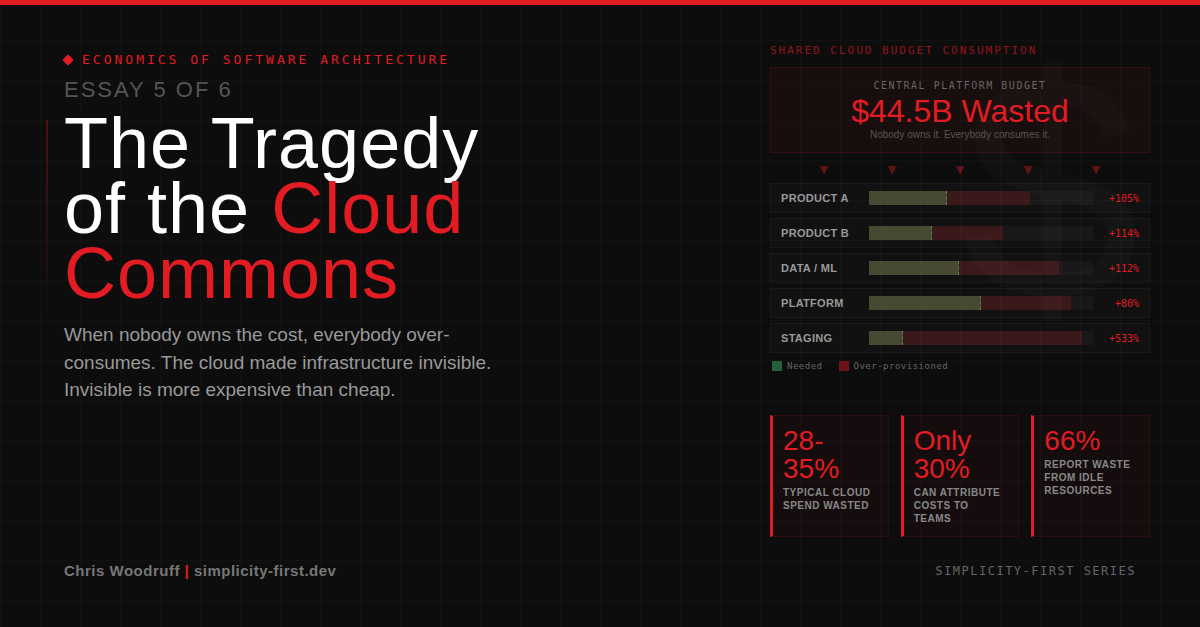
Your cloud bill is 34% over budget. Nobody is responsible.
Not because people are hiding. Because the structure makes responsibility invisible. The platform team points to the product teams. The product teams point to traffic spikes and necessary headroom. Every explanation is true. The bill keeps growing anyway.
Essay 5 of my Economics of Software Architecture series explains why. It is called “The Tragedy of the Cloud Commons,” and it is live now on my Simplicity-First Philosophy publication.
The argument borrows from Garrett Hardin’s 1968 paper in Science. When a shared resource has no individual cost for consumption, rational actors will collectively over-consume it. Your cloud infrastructure is that shared resource. The platform budget is the pasture. Each team is a herder. Over-provisioning is the extra sheep. The benefit (performance headroom, your service not being the one that fails) is private. The cost (a larger bill) is socialized. Every team’s incentive is to over-provision. And $44.5 billion in projected cloud waste for 2025 is the aggregate result.
The essay diagnoses why FinOps addresses symptoms but not the incentive structure. It breaks down the four failures of chargeback: attribution (shared infrastructure recreates the commons inside the chargeback system), gaming (teams manipulate allocation rules), granularity (the feedback loop never reaches the person writing the Terraform file), and the architecture ceiling (chargeback cannot reduce costs below the floor the architecture sets).
Then it draws on Elinor Ostrom’s Nobel Prize-winning commons governance research to propose mechanisms that work: team-level budgets with architectural constraints, cost-per-feature as the unit metric, and the finding that simplifying architecture saves 60-90% while right-sizing saves 10-15%.
The biggest cost lever is not cost management. It is architecture.
Read it here:
