


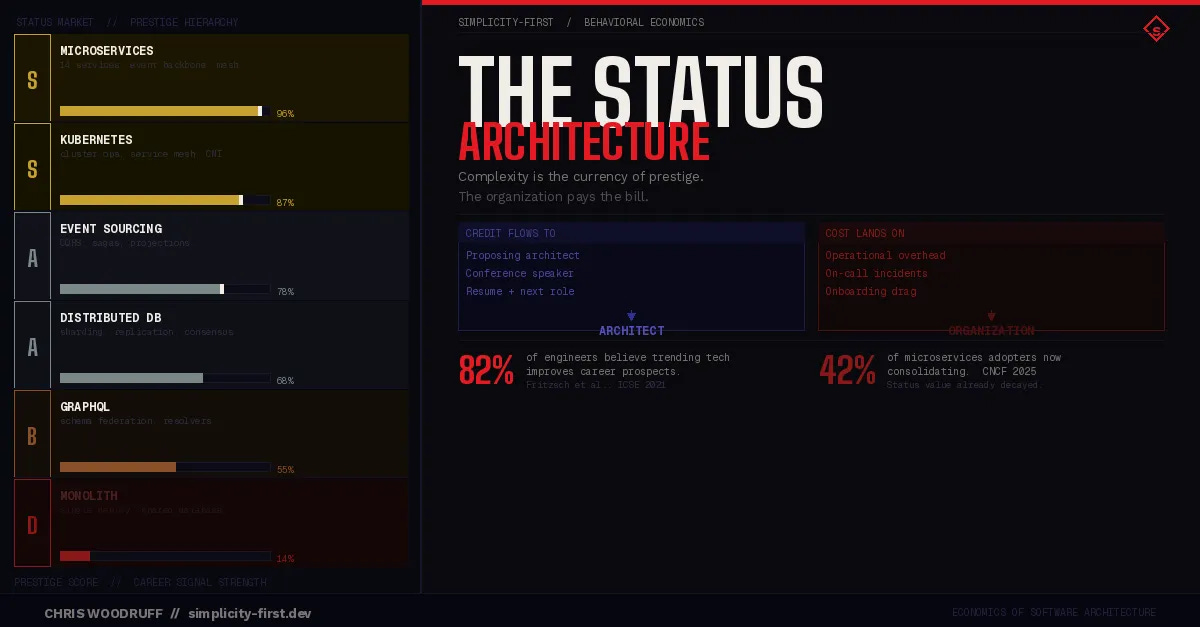
The conference talk was excellent. Fourteen microservices, event-driven choreography, a custom service mesh and a polyglot persistence layer with four database engines. The architect who built it received a standing ovation and an offer for a senior staff position at a bigger company within six weeks.
The system the talk described had been in production for eleven months. It served 4,000 daily active users. A modular monolith on PostgreSQL would have served them with one-tenth of the operational overhead.
Nobody asked.
This is the open secret of the modern engineering market. Complexity is the currency of technical prestige. Sophisticated systems earn conference talks. Simple systems do not. Senior engineers who advocate for the modular monolith have less career capital than those who migrate to microservices, even when the monolith is the correct decision for the business.
The labor market values complex experience. The next employer pays the salary uplift for complex architecture. The architect who builds simple systems competes for the same roles against architects whose resumes list more sophisticated stacks. The market consistently rewards the wrong behavior at scale.
Three actors profit from this equilibrium. The architects who build complex systems and ride the resume to the next role. The cloud providers and tooling vendors whose revenue scales with the complexity. The conference and training industry, whose entire business model assumes the audience needs to learn the next sophisticated pattern.
The actor who pays is the organization. The bill arrives over the years, in cloud invoices, operational overhead, and the engineering capacity consumed by maintaining systems that did not need to be complex in the first place.
Read more at the link below.
