


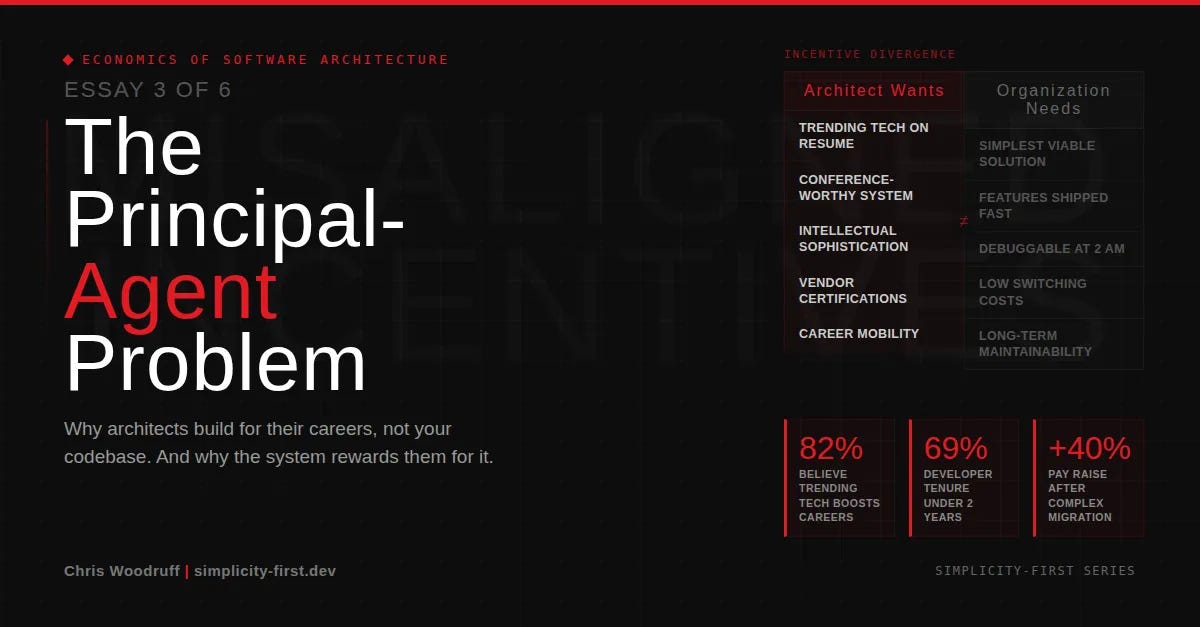
Essay 3 of the Economics of Software Architecture series is live on my Simplicity-First Philosophy publication.
It’s called “The Principal-Agent Problem,” and it answers the question that Essays 1 and 2 both raised: if the architecture tax is so large and the opportunity cost so destructive, why do smart architects keep making decisions that maximize both?
The opening scenario: a senior architect proposes migrating the company’s modular monolith to Kubernetes. Six months and four engineers later, the deployment pipeline is sophisticated. The YAML files fill a repository. Eight months after that, the architect leaves. The LinkedIn announcement: “Led enterprise Kubernetes migration.” New role pays 40% more. Back at the original company, three engineers now maintain the infrastructure full-time.
This is not a story about a bad architect. It is a story about rational behavior in a system with broken incentives.
The research behind it: a 2021 ICSE study of 591 software professionals found that 82% believe trending technologies improve their career prospects. Both hiring managers and candidates acknowledge the emphasis is overstated relative to actual value. Neither side can unilaterally stop. The researchers called it Resume-Driven Development, and it is a peer-reviewed coordination failure with direct architectural consequences.
The essay also applies Michael Spence’s signaling theory (why complexity functions as a costly career signal with no natural ceiling), examines vendor capture (8.25 million workers trained in vendor-specific programs in the first half of 2024), explains why architecture review boards fail (the monitors share the monitored’s incentive structure), and proposes mechanism design solutions drawn from Elinor Ostrom and game theory.
The architect who builds a complex system and leaves has made a rational economic decision. The irrationality is in the system that rewarded them.
Read the full essay here:
