


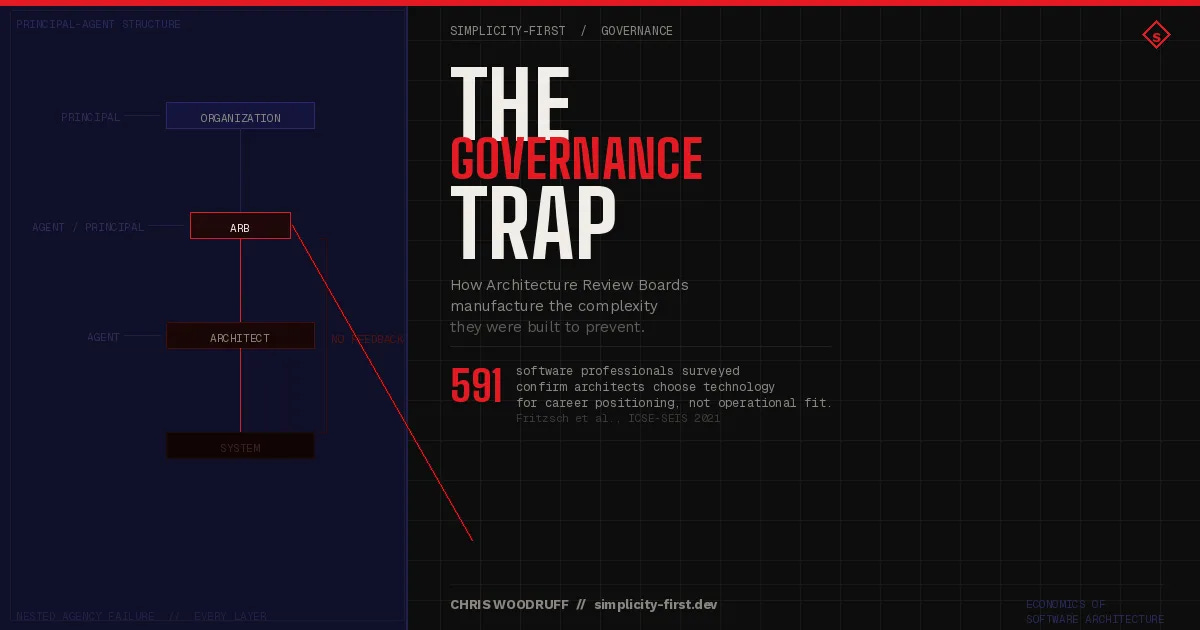
Your architecture review board was created to prevent complexity. It is producing more of it.
That is the argument I make in this week’s essay over at Simplicity-First Philosophy, and the evidence is not subtle.
Walk into any ARB meeting. Listen to the questions. “What about international expansion?” “What about ten times the load?” “What if we need to swap databases later?” Every question is reasonable. Every question adds an edge case. Every edge case adds a service, a layer, a contract.
Nobody gets criticized for raising a concern. Everyone gets criticized for missing one.
So the meeting reaches its quiet equilibrium: everybody adds complexity, nobody removes it. The board signs off feeling diligent. The architect leaves with three new requirements. The system gets heavier. Multiply that by every quarterly review for the past five years, and you get the architecture you have.
And the meeting is only the visible part. The problem is not the people in the room. The problem is the rules of the game.
The essay walks through three reasons review boards cannot fix what they were built to fix:
Reviewers share the same incentive structure as the reviewed. Asking architects to evaluate whether an architecture is over-engineered is asking them to question the value of their own resumes.
The simpler alternative is invisible. The twelve microservices got built. The modular monolith did not. You cannot defend a system that was never given a chance to exist.
The review process measures documentation, not design. Forty-seven slides and a risk matrix score higher than a one-page ADR that clarifies the actual decision. Completeness is legible. Quality of judgment is not.
The full essay covers what to put in place of ARB theater: lighter governance, ADRs with breakeven analysis, and a single rule that changes the whole conversation.
Kill the bloat. Start with the meeting that creates it.
Read it here:
