


Quick note today to point you toward something I’ve been working on for months.
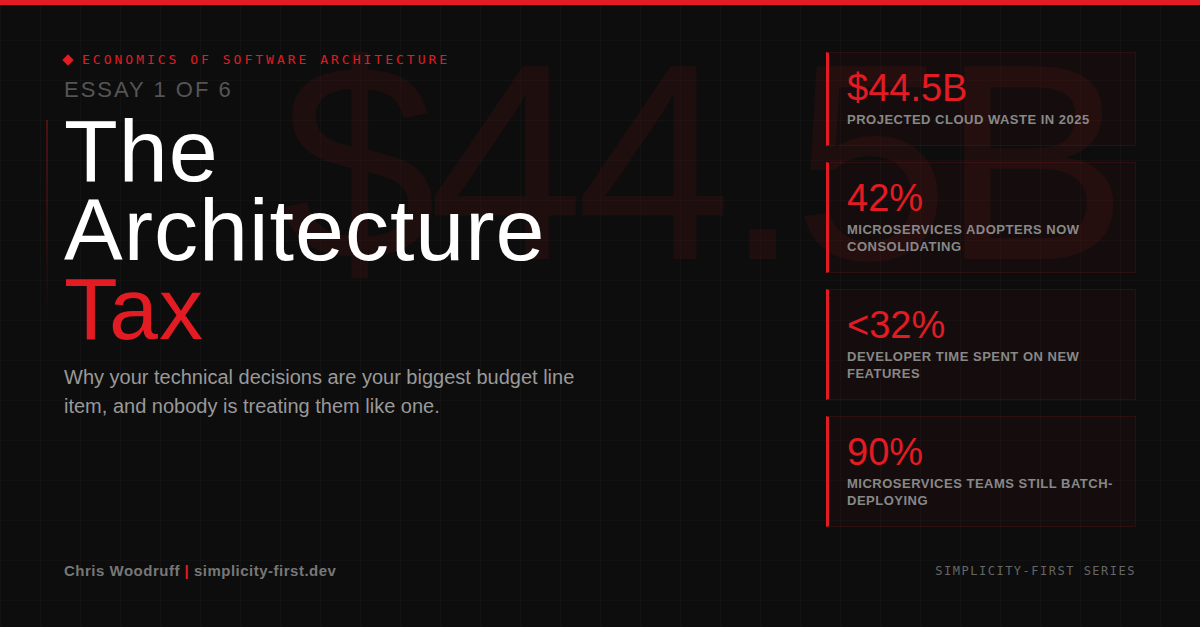
I just published the first essay in a six-part series called “Economics of Software Architecture” over on my Simplicity-First Philosophy publication. It’s called “The Architecture Tax,” and it opens with a scene you’ll probably recognize:
A team of engineers stands around a whiteboard. In 45 minutes, they commit the organization to an infrastructure pattern that will cost between $200/month and $65,000/month. Nobody has a spreadsheet open. Nobody has consulted finance.
If anyone proposed a $500K annual expenditure without a business case, they’d be shown the door. Yet architects make decisions of equal magnitude in whiteboard sessions every week.
The essay digs into why this keeps happening and what it actually costs. Some of the numbers that went into it:
$44.5 billion in projected cloud waste for 2025. Amazon’s own Prime Video team discovered that its distributed architecture failed at 5% of expected load, then cut costs by 90% through consolidation. 37signals left AWS and saved $2 million per year. 42% of microservices adopters are now consolidating back.
It also introduces a Total Cost of Architecture calculation that covers the five cost categories most organizations never track: infrastructure premiums, operational overhead, coordination burden, cognitive load, and opportunity cost. There’s a diagnostic at the end you can run against your own systems.
This is the first of six essays. Each one applies a different economic concept to a specific failure in the industry's decision-making process. Opportunity cost, principal-agent theory, compound interest on technical debt, commons economics, and sunk cost fallacy are all coming.
Read the full essay here:

I think it’ll change how you look at your next whiteboard session.