


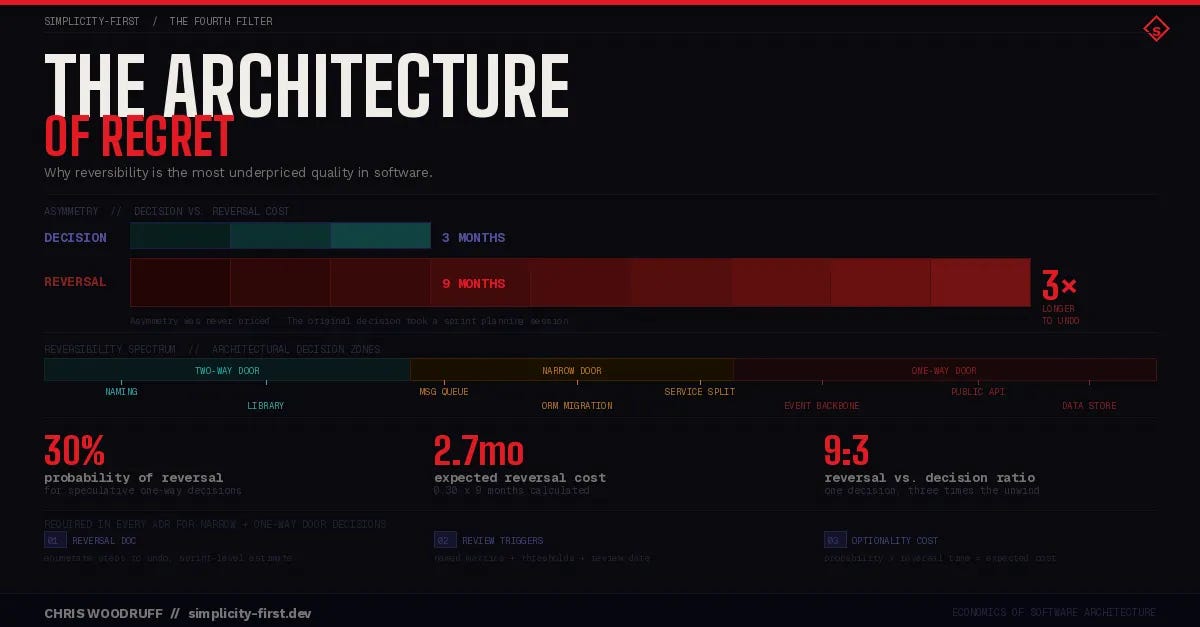
The decision to split those services took three months.
Undoing it will take nine months.
Nobody wrote that ratio in the Architecture Decision Record. Nobody calculated the asymmetry before committing. The decision was made based on the cost of building. The cost of unbuilding, three times larger, was never priced. It rarely is.
Every architectural decision sits on a spectrum. Two-way doors can be reversed in a sprint. Narrow doors feel reversible but create structural dependencies that make reversal expensive. One-way doors are effectively permanent within any realistic planning horizon.
The classification error that produces nine-month reversal projects is treating narrow or one-way door decisions like two-way doors. The technology is familiar. The pattern is well understood. The permanence is invisible until the day you need to go back and discover you cannot.
None of the Three Filters, the 2 AM Test, the Half-Rule, Primary Path First, asks about reversibility. The Filters evaluate whether the architecture is operable, scoped, and organized. Only the fourth filter, the Reversibility Test, asks whether the level of commitment matches the level of certainty.
Reversibility is the most underpriced quality in software. Every one-way door looks like a corridor until you need to go back. The option to course-correct has real economic value. Every irreversible decision forfeits it. The organizations that survive the accumulation of one-way doors are the ones that priced reversibility before the door closed.
The decision that costs one sprint to make can cost three quarters to reverse. Which decisions in your current architecture would you be willing to remake with full knowledge of the cost of reversing them?
