


Nobody has ever calculated the interest rate on your technical debt.
Not approximately. Not roughly. Not at all.
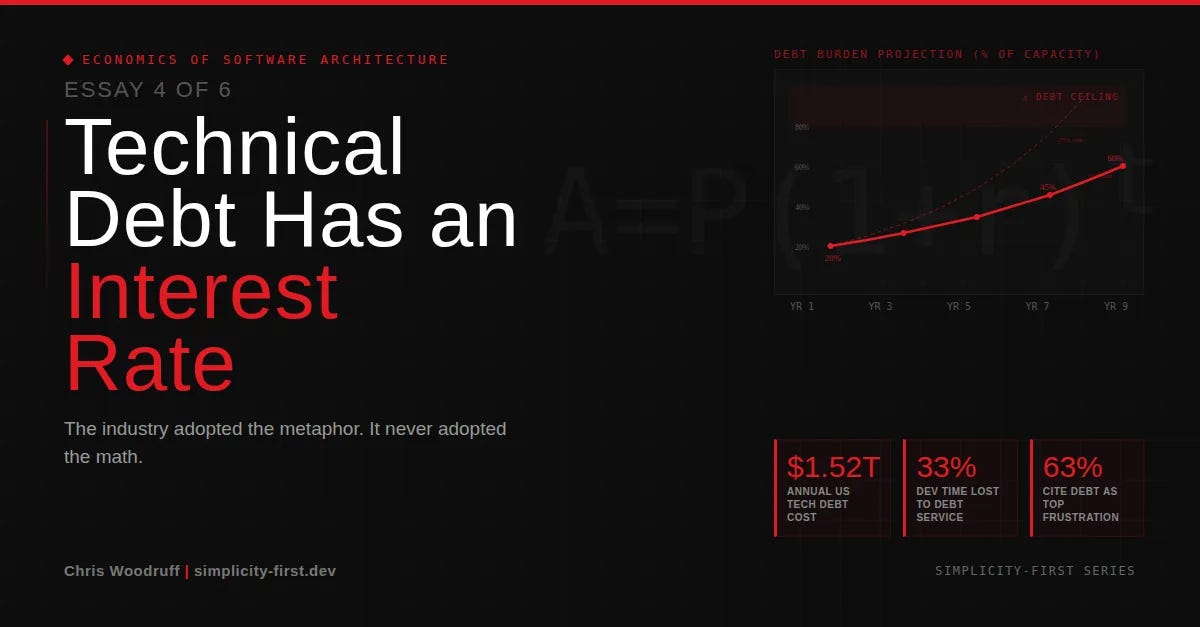
Teams talk about technical debt constantly. They calculate it almost never. Ward Cunningham gave us the metaphor in 1992, and we took the language without doing the arithmetic. “We have some tech debt we should address” became the industry’s most comfortable way to avoid quantifying a problem that costs US companies $1.52 trillion annually.
Essay 4 of my Economics of Software Architecture series does the arithmetic. It is called “Technical Debt Has an Interest Rate,” and it is live now on my Simplicity-First Philosophy publication.
The essay maps every component of financial debt onto its technical equivalent. Principal: the gap between what was built and what should have been built. Interest rate: the additional time every task takes because of accumulated shortcuts (33-50% for typical teams, over 100% for severely indebted codebases). Carrying cost: $495,000 per year for a 10-person team losing a third of its capacity to maintenance. Default: the point where all engineering effort goes to servicing existing debt and no new value can be created.
