


Essay 2 of the Economics of Software Architecture series is live on my Simplicity-First Philosophy publication.
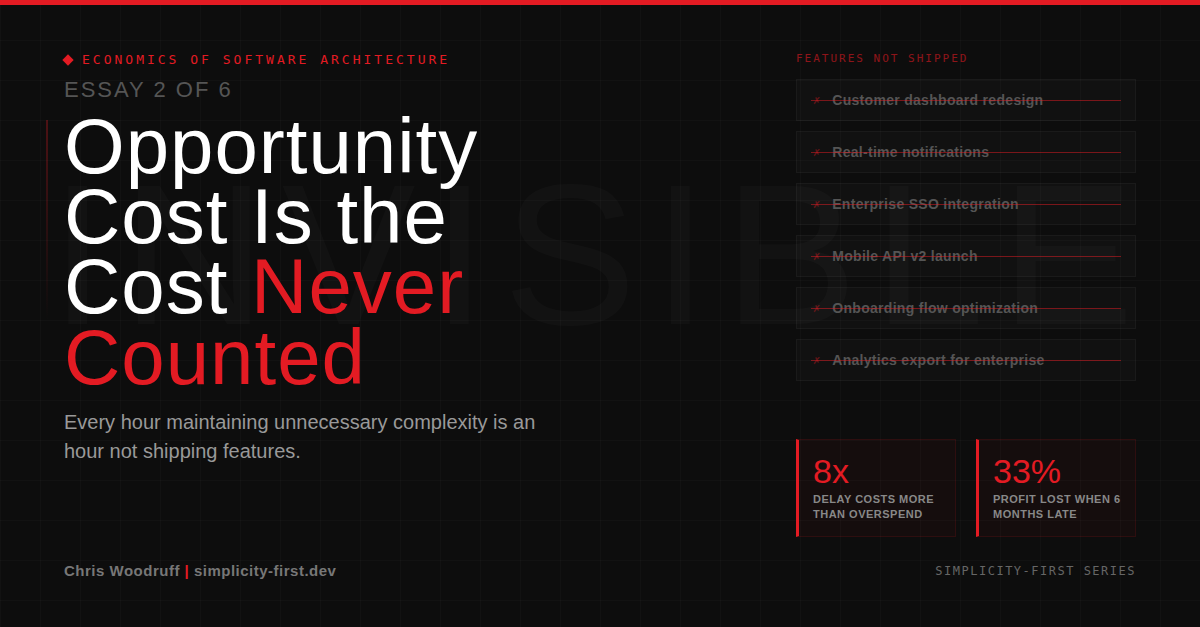
It’s called “Opportunity Cost Is the Cost Architects Never Count,” and it picks up where “The Architecture Tax” left off. Essay 1 asked what your architecture costs. This one asks what it cost you not to build.
The opening scenario: a product team finishes a six-month microservices migration. The deployment pipeline is elegant. The service mesh is configured. The architecture review board signs off. Everyone is proud. Meanwhile, 47 customer-requested features sit untouched in the backlog. Three competitors have shipped capabilities users have been asking for. NPS has dropped four points.
The team built something impressive. They just didn’t build anything customers wanted.
That’s opportunity cost, and it’s the most expensive line item in software because it’s the one nobody measures. The essay makes it measurable.
Some of the research that went into it: McKinsey found that a product six months late to market loses 33% of profit over five years. Being 50% over budget? Only 4%. Delay is 8x more expensive than overspend. Segment spent $450-600K per year in direct costs maintaining 140 microservices, but the opportunity cost (12 unshipped features, lost feedback cycles, eroded competitive position) ran $2-5 million. DORA data shows elite performers deploy on-demand, running 365 experiments per year. Low performers deploy monthly: 12 experiments. That’s a 30x learning gap created entirely by architectural choices.
The essay also applies lean manufacturing’s seven wastes to software architecture and introduces an opportunity cost ledger you can run against your own sprints.
This is the invisible twin of the Architecture Tax. The money you spent is on the invoice. The money you lost is not.
Read the full essay here:
